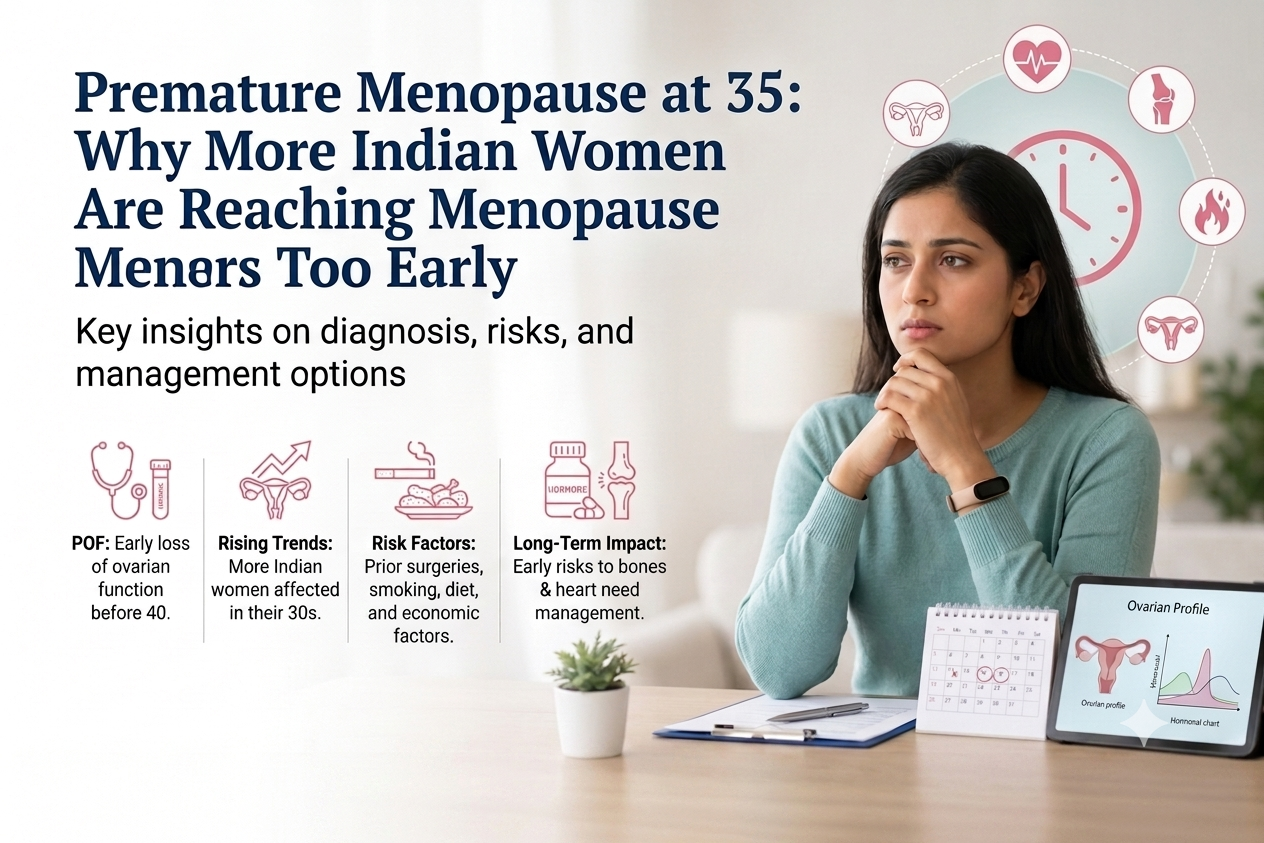
Menopause, in most women’s minds, belongs firmly in the late forties or early fifties. For a growing number of Indian women, that assumption no longer holds. A detailed national analysis based on India’s most recent large-scale health survey found that the proportion of women experiencing premature menopause — defined as menopause occurring before the age of 40 — has been rising, with the increase concentrated specifically among women in their thirties. This is a development that deserves far more public attention than it currently receives.
What Premature Ovarian Insufficiency Actually Is
The medical term for this condition is premature ovarian insufficiency, often shortened to POI, and it describes the loss of normal ovarian function — and the hormones that come with it — before the age of 40. It can present as periods stopping altogether, or as increasingly irregular cycles accompanied by classic menopausal symptoms: hot flushes, night sweats, mood changes, and vaginal dryness, all occurring in a woman who, by most expectations, should still be a decade or more away from menopause.
What the Indian Research Points To
The same national-level study identified several factors strongly associated with earlier menopause in India, including prior surgical removal of the ovaries or uterus, lower educational attainment, poorer economic circumstances, smoking, and a diet heavy in fried food. Interestingly, the data showed premature menopause was actually more common among women with lower levels of education than among those with higher education — a reminder that this is not purely a condition of urban, high-stress professional life, but one shaped by a complex mix of healthcare access, surgical history, and lifestyle factors across the country.
Why Early Recognition Genuinely Matters
Beyond the fertility implications — which are significant, since natural conception becomes very difficult once ovarian function has substantially declined — premature menopause carries real long-term health consequences if left unaddressed. Oestrogen plays a protective role in bone density and cardiovascular health, and losing that protection a decade or more earlier than expected meaningfully raises the long-term risk of osteoporosis and heart disease if hormonal support is not considered. This is precisely why a woman in her early thirties experiencing unexplained irregular or absent periods, particularly alongside menopausal-type symptoms, should not simply assume stress is the cause and wait it out.
What Can Be Done
If POI is confirmed through hormonal blood testing, the conversation moves to two related but distinct questions: managing the hormonal consequences (often through appropriately prescribed hormone therapy, to protect bone and cardiovascular health) and addressing fertility, where options range from attempting to identify any treatable underlying cause to donor egg IVF for women who wish to carry a pregnancy themselves. Neither path is something to navigate from internet research alone — a proper diagnostic work-up, including repeat hormone testing on more than one occasion, is the necessary first step before any decision is made.
Every woman’s situation is different, and the only way to get an answer specific to you is a proper consultation. Call +91 7045947047 or email info@jkwomenhospital.com to speak with our team.