Few women’s health topics have generated as much genuine national conversation in recent months as menstrual leave. The debate reached the Supreme Court of India, attracted comment from chief ministers, HR departments, and start-up founders alike, and surfaced a question that has quietly affected millions of working women for generations: should a woman be entitled to paid time off work when menstrual pain genuinely affects her ability to function?
What the Supreme Court Actually Ruled
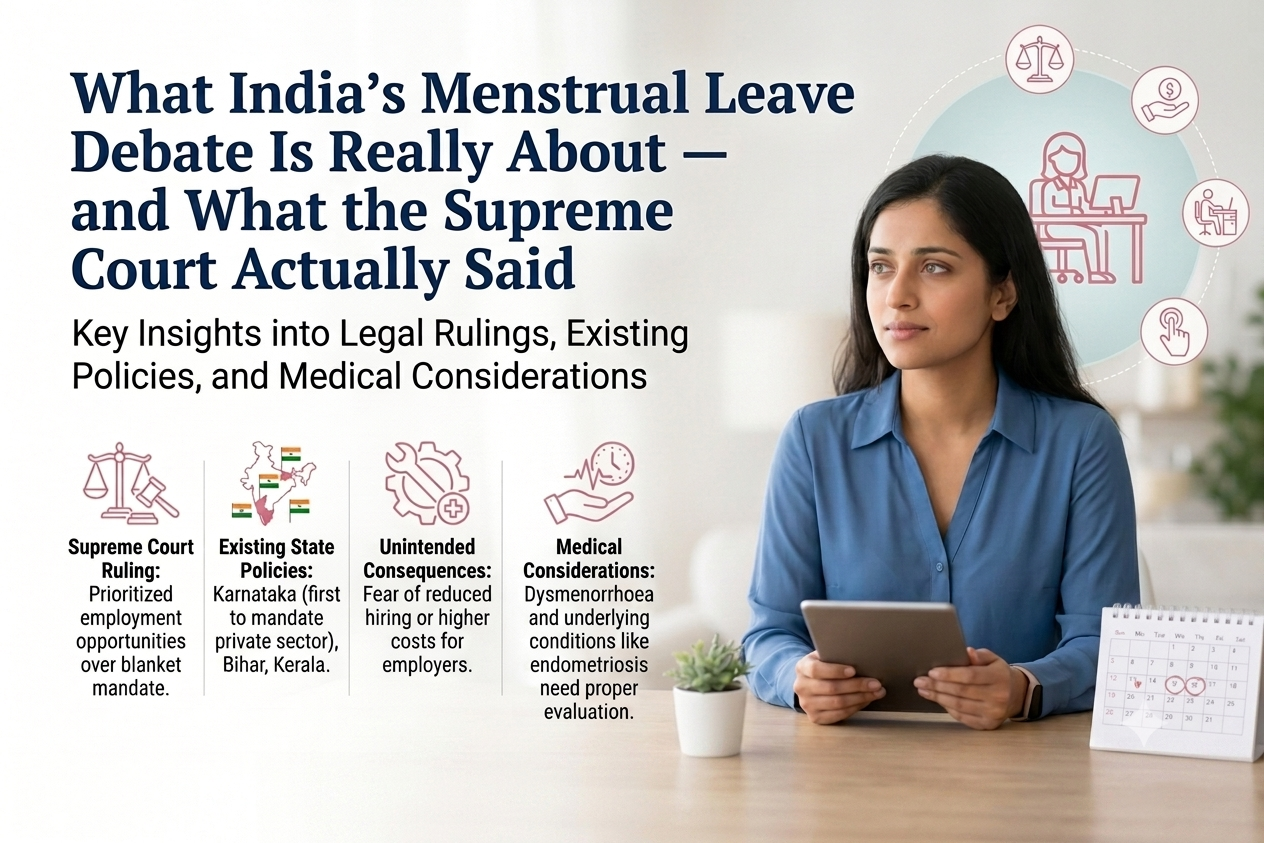
In March 2026, the Supreme Court declined to direct the central government to mandate a uniform, nationwide paid menstrual leave policy for all employers, in response to a petition seeking exactly that. The Court’s reasoning was not that menstrual pain is unimportant — quite the opposite — but that making such leave a compulsory legal obligation on every employer risked an unintended consequence: employers becoming more reluctant to hire women in the first place, out of cost or scheduling concerns. The bench specifically praised states and private companies that have introduced such policies voluntarily, calling on the central government to consult stakeholders and consider a more carefully designed framework rather than a blanket mandate. Separately, in an earlier related matter, the Court had already recognised menstrual health and hygiene as connected to the fundamental right to life and dignity.
Where Policy Already Exists in India
Despite the absence of a national law, several Indian states have moved ahead independently. Bihar has provided menstrual leave to government employees since as far back as 1992. Kerala has introduced provisions for students and trainees. Most notably, Karnataka approved a state-wide policy in late 2025 granting one paid day of menstrual leave per month — twelve days a year — to women across government and private sector employment, including contract and outsourced workers, making it the first Indian state to extend such a mandate into the private sector, though the policy has also faced legal challenge. A number of private companies, including several well-known technology and consumer firms, have introduced voluntary menstrual leave policies of their own, ahead of any state requirement.
The Medical Reasoning Behind the Debate
From a clinical standpoint, the debate is grounded in something genuinely real: dysmenorrhoea, or painful periods, affects a very large proportion of menstruating women to a degree that measurably interferes with concentration and physical comfort during the most intense day or two of bleeding, and research has repeatedly shown this directly affects work performance and productivity for many women. For some women, particularly those with underlying conditions such as endometriosis, adenomyosis, or large fibroids, period pain is not a minor inconvenience but a genuinely disabling symptom requiring proper medical evaluation — not just a day’s rest.
What This Means for You
If your periods cause pain severe enough that you regularly need to take time off, miss important commitments, or simply push through significant discomfort each month, that is worth raising with a gynaecologist rather than accepting as an unavoidable part of being a woman. Severe, disruptive period pain is frequently a treatable medical symptom with an identifiable cause, and identifying that cause matters more than any single policy debate happening in Parliament or the courts.
If any of this resonates with your own situation, Dr. S. Krishnakumar and the team at JK Women Hospital, Dombivli, are happy to talk it through with you. Call +91 7045947047 or write to info@jkwomenhospital.com to book a consultation.