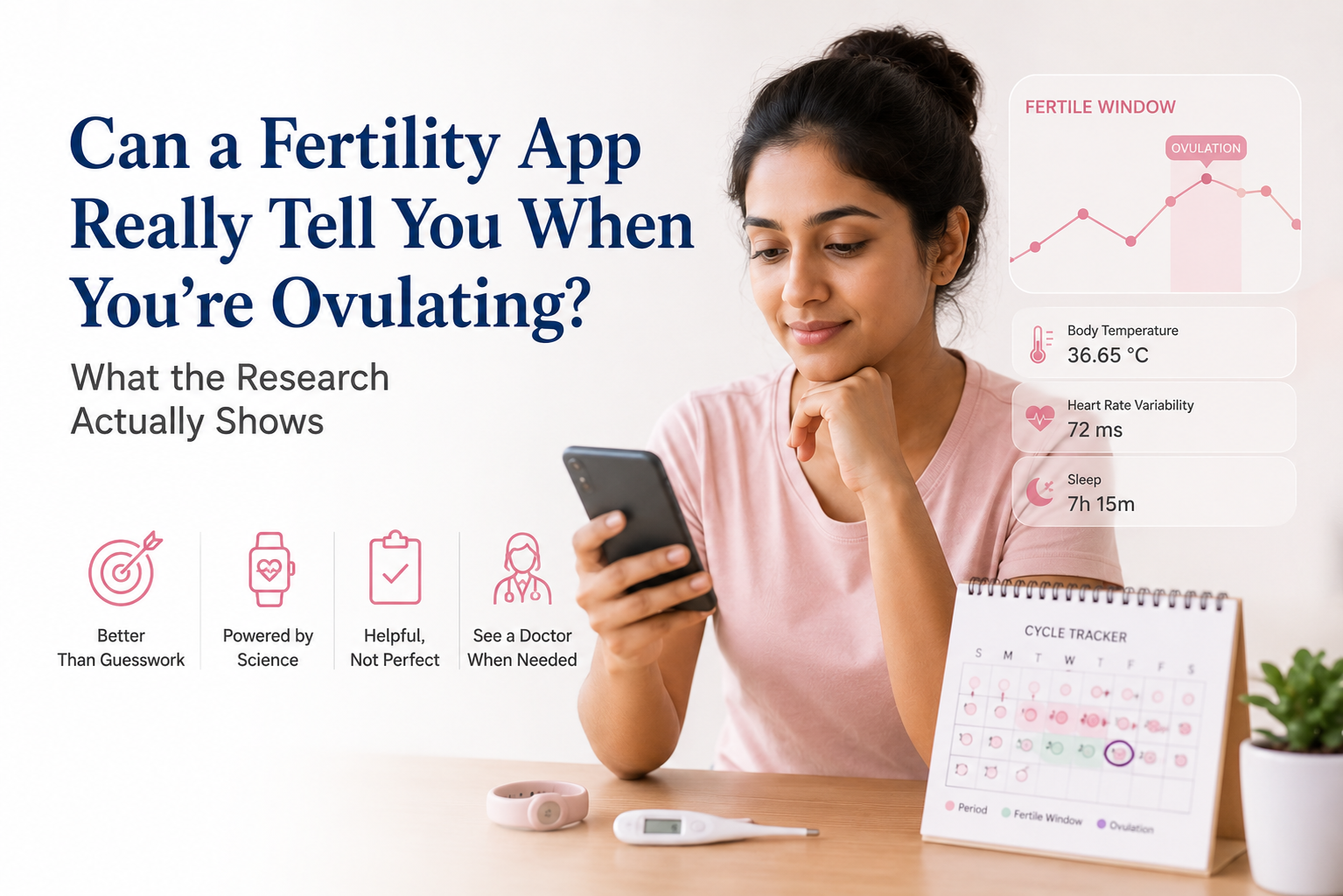
Open the app store on almost any smartphone in urban India today, and you will find a long list of period and ovulation tracking apps, many with millions of downloads, alongside a newer generation of wearable devices — rings and bracelets — that claim to detect your most fertile days using body temperature and other physiological signals. For couples trying to conceive, this technology has become a genuinely common starting point, often before any conversation with a doctor. But how accurate is it, really?
What the Research Actually Found
A comprehensive analysis published in 2025, pooling data from numerous studies on wearable fertility-tracking devices, found that these tools achieved a respectable overall accuracy of around 88 percent in detecting the fertile window, with particularly strong performance in identifying the three-day period surrounding ovulation itself. Devices that combined multiple physiological signals — temperature, heart rate variability, and others — using more sophisticated algorithms tended to outperform simpler, single-signal devices. This is a genuinely encouraging result, considerably better than relying purely on calendar-based guesswork.
Where the Accuracy Drops Significantly
The same body of research consistently flags an important caveat: these tools were generally validated in women with regular, predictable menstrual cycles. Their accuracy drops meaningfully for women with irregular cycles, conditions such as PCOS, thyroid disorders, or those undergoing IVF, where hormonal patterns differ from the population on which the underlying algorithms were trained and tested. An app or wearable confidently predicting your fertile window is of limited use if your cycle itself does not follow a predictable pattern in the first place.
What These Tools Are Good For — and What They Are Not
For a woman with regular cycles simply trying to identify her most fertile days to time intercourse, a good-quality tracking app or wearable is a reasonable, evidence-supported aid, and considerably more reliable than purely counting days on a calendar. What these tools cannot do is replace a proper fertility evaluation. An app cannot tell you whether you are actually ovulating at all, whether your fallopian tubes are open, whether your partner’s sperm parameters are normal, or whether an underlying condition is affecting your chances of conceiving. If a couple has been trying for six months to a year without success while diligently tracking ovulation through an app, the right next step is a doctor’s evaluation, not a different or more expensive app.
A Practical Way to Use These Tools
Used as one input among several — alongside attention to your own cycle pattern, and conversation with a doctor if anything seems off — fertility tracking technology genuinely earns its growing popularity. Used as a substitute for medical evaluation when conception is not happening on the expected timeline, it can quietly delay a diagnosis that, addressed earlier, might have led to a faster, simpler resolution.
If any of this resonates with your own situation, Dr. S. Krishnakumar and the team at JK Women Hospital, Dombivli, are happy to talk it through with you. Call +91 7045947047 or write to info@jkwomenhospital.com to book a consultation.