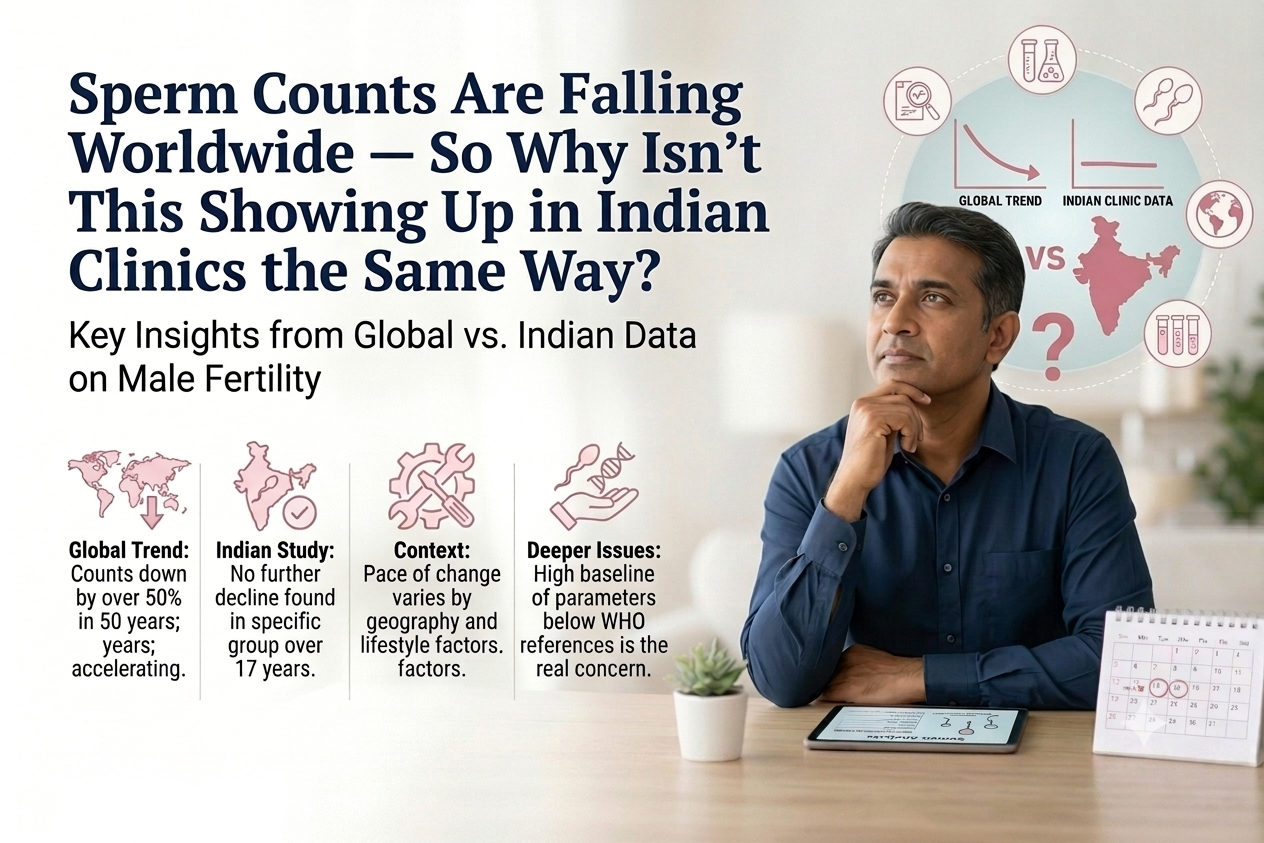
A landmark international analysis, pooling data from over fifty countries, concluded that average sperm counts worldwide have fallen by more than half over roughly the last five decades, with researchers describing the trend as accelerating in recent years and warning of broader implications for human reproductive health. Headlines built around this finding have circulated widely in India too, often with alarming framing. But a detailed, recently published Indian study tells a more layered story — and the nuance matters for any couple currently worried about male fertility.
What the Global Data Actually Shows
The international research is genuinely robust and has been replicated across multiple regions, including, in its most recent extension, parts of Asia, South America, and Africa that earlier studies had not adequately covered. Researchers link the broader pattern to a combination of environmental exposures, lifestyle changes, and possibly disruptions occurring even during foetal development, affecting reproductive health over a lifetime. This is a real and serious global trend, not a manufactured panic.
What a Major Recent Indian Study Found
A detailed seventeen-year analysis from a leading South Indian medical research centre, reviewing semen samples from over twelve thousand men evaluated for fertility concerns between 2006 and 2022, found no significant downward trend in sperm concentration, motility, or shape over that period in this specific population. This does not contradict the global research so much as it adds an important regional dimension — the pace and pattern of decline, where it exists, appears to vary meaningfully by geography, diet, environmental exposure, and lifestyle, rather than following one uniform global curve.
The Detail That Matters More Than the Headline
Here is the part of the Indian research that deserves more attention than it has received: even though semen quality in this study group did not appear to be falling further over time, a meaningful proportion of the men studied still had semen parameters below World Health Organisation reference values for fertile men. In other words, stability at a low baseline is not the same as good news. A separate, more recent Indian study on lifestyle and hormonal factors found clear links between smoking, alcohol use, occupational heat exposure, and both poor sperm parameters and DNA damage to sperm — damage that standard semen analysis does not even measure.
What This Means for an Indian Couple Today
The honest, current picture is this: male infertility is a major and growing reason couples seek fertility treatment in India, contributing to roughly four in ten infertility cases, but the cause is more often a combination of modifiable lifestyle factors — tobacco, alcohol, obesity, chronic heat exposure from laptops or certain occupations, and chronic stress — than an unstoppable global decline that nothing can be done about. A basic semen analysis, the test couples are sometimes reluctant to request for the male partner, remains the essential first step, and where parameters are abnormal, deeper testing such as sperm DNA fragmentation analysis and a hormonal profile can reveal issues a standard report misses entirely.
If any of this resonates with your own situation, Dr. S. Krishnakumar and the team at JK Women Hospital, Dombivli, are happy to talk it through with you. Call +91 7045947047 or write to info@jkwomenhospital.com to book a consultation.