Walk into almost any diagnostic lab in urban India today and ask about fertility testing, and the conversation will turn quickly to one acronym: AMH. Anti-Müllerian Hormone testing has become something of a cultural moment among young, educated, urban Indian women, often requested not because a doctor recommended it, but because a friend, a colleague, or a social media post suggested it as a sensible thing to check, almost like a routine blood sugar test. The trend reflects something genuinely positive — women taking active interest in their reproductive health rather than leaving it to chance. But the test is also widely misunderstood, and that misunderstanding is causing a great deal of avoidable anxiety.
What AMH Actually Measures
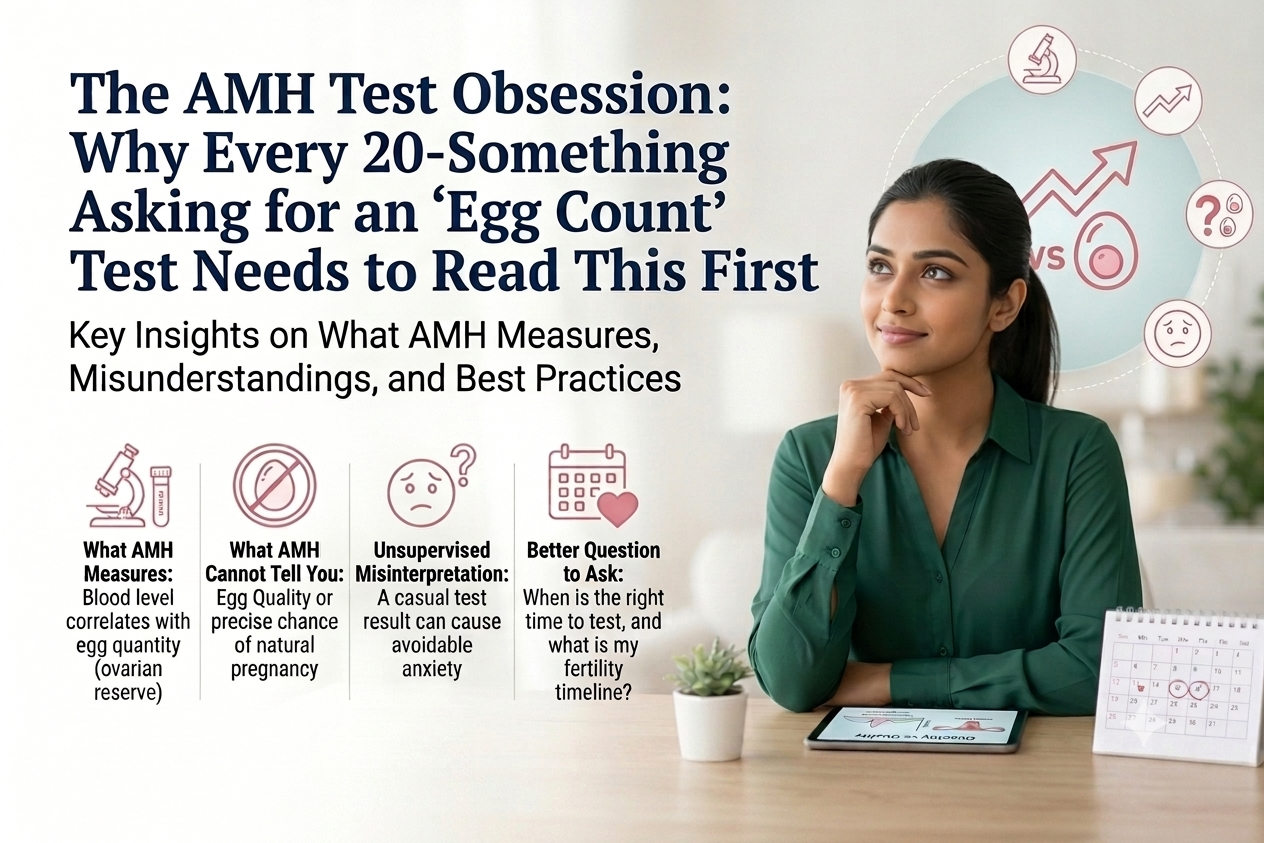
AMH is a hormone produced by the small, early-stage follicles in the ovaries, and its blood level correlates reasonably well with the total number of eggs remaining in a woman’s ovarian reserve — essentially, egg quantity. It is a genuinely useful, stable marker that, unlike some other fertility hormones, does not need to be timed to a specific day of the menstrual cycle, which is part of why it has become so popular as a quick, convenient test.
What AMH Cannot Tell You
Here is the critical gap that rarely makes it into casual conversation: AMH reflects egg quantity, not egg quality, and it does not predict your natural chance of pregnancy with any precision. A 28-year-old with a slightly lower-than-average AMH can still conceive naturally without difficulty, while a woman with an excellent AMH level is not guaranteed an easy pregnancy, since quality issues, tubal factors, uterine conditions, or her partner’s fertility may matter just as much. Treating a single AMH number as a verdict on your fertility — good or bad — is simply asking the test to do something it was never designed to do.
Why Doctors Worry About the Casual, Unsupervised Use of This Test
Fertility specialists are increasingly cautious about a pattern that has become common: a healthy 24-year-old with regular periods and no fertility concerns requesting an AMH test purely out of curiosity, receiving a result with no context or interpretation, and then spending weeks anxious over a number she does not fully understand. A test ordered without a clear clinical reason, and without proper counselling on how to interpret it, can generate worry that serves no useful purpose. On the other hand, the test becomes genuinely valuable — even essential — for women with irregular or absent periods, a family history of early menopause, a diagnosis of PCOS or endometriosis, or anyone actively planning IVF, where the result directly shapes medication dosing.
The Better Question to Ask
Rather than asking “what is my AMH,” a more useful starting question is “do I have a specific reason to test my ovarian reserve right now, and if the result comes back low, what would I actually do differently?” If the honest answer to the second half of that question is “nothing, right now,” it may be more useful to have a broader conversation with a gynaecologist about your overall reproductive health and timeline, rather than reducing the entire question to a single number on a lab report.
Every woman’s situation is different, and the only way to get an answer specific to you is a proper consultation. Call +91 7045947047 or email info@jkwomenhospital.com to speak with our team.