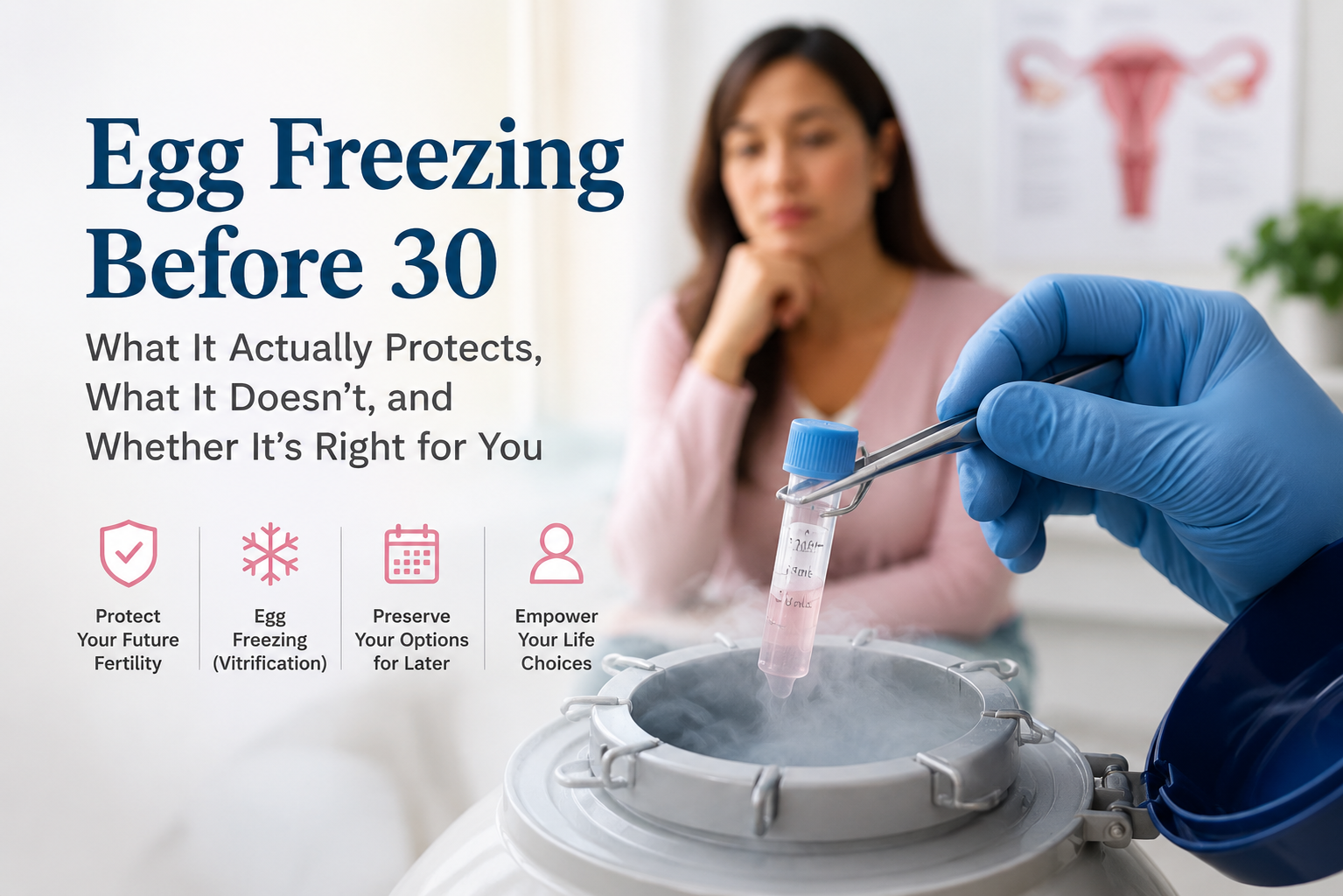
Search interest in “egg freezing” has climbed sharply across Indian cities over the past year, and the conversation has moved well beyond Instagram reels. In Mumbai, Bengaluru, and Delhi, fertility clinics report a steady rise in enquiries from women in their late twenties and early thirties — not women in crisis, but women planning ahead. The market for egg freezing and embryo banking in India has grown rapidly in just a few years, and industry estimates suggest it will continue to expand at a fast pace through the rest of this decade. So what is actually going on, and does freezing your eggs in your twenties make medical sense, or is it simply the latest wellness trend dressed up in clinical language?
What Egg Freezing Actually Does
Egg freezing, medically known as oocyte cryopreservation, involves stimulating the ovaries with hormonal medication for around ten to twelve days, retrieving the resulting eggs under light sedation, and then flash-freezing them using a technique called vitrification. The frozen eggs are stored, sometimes for years, until the woman is ready to use them — at which point they are thawed, fertilised with sperm, and the resulting embryo is transferred to the uterus. What it protects is simple and important: it preserves eggs at the age they were frozen, rather than the age at which they are eventually used. A 32-year-old’s eggs, frozen and thawed at 40, still carry the chromosomal profile of a 32-year-old’s eggs.
What It Does Not Promise
This is the part that often gets lost in casual conversation. Egg freezing is not an insurance policy with a guaranteed payout. Not every frozen egg survives thawing, not every thawed egg fertilises, and not every resulting embryo implants successfully. Doctors generally explain that more eggs banked means a better statistical chance later, which is precisely why women who freeze in their twenties, when egg yield per cycle tends to be higher, often need fewer cycles overall than women who wait until their late thirties to start the process. A high egg count from a single cycle is reassuring, but it is not the same thing as a confirmed future baby.
Does the Egg Really ‘Stay Active’? Addressing the Common Question
A question we hear often, particularly from younger patients, is whether a frozen egg somehow weakens, ages, or loses its viability the longer it sits in storage. With modern vitrification technology, a properly frozen and stored egg does not deteriorate with the passage of storage time itself — an egg frozen for two years and one frozen for eight years have essentially the same survival and fertilisation potential on thawing, provided storage conditions have been maintained correctly throughout. What matters far more than storage duration is the age of the woman at the time of freezing, and the technical quality of the freezing process itself. This is genuinely reassuring information, and one of the few areas of this topic where the science is settled rather than still evolving.
So Who Should Actually Consider It?
Egg freezing tends to make the most medical sense for three groups of women: those in their late twenties to early thirties who know, with reasonable confidence, that they want children eventually but are not in a position to start now; those with a medical diagnosis such as endometriosis or a family history of early menopause that may threaten future fertility; and women about to undergo cancer treatment or other therapy that could damage ovarian function. For a woman in her early twenties with no specific risk factor and no clear timeline in mind, freezing eggs purely out of generalised anxiety is a more debatable decision, and one worth discussing properly with a specialist rather than deciding alone after reading a viral post.
A Word on Cost and Realistic Planning
In India, a single egg freezing cycle — covering the initial fertility assessment, stimulation medication, monitoring, retrieval, and vitrification — typically costs a fraction of what the same process would cost in the United States or the United Kingdom, with ongoing annual storage charges on top. Costs vary by individual stimulation needs, so a proper written estimate after assessment matters more than any number quoted online. Some women, particularly those with a lower ovarian reserve, may need more than one cycle to bank a sufficient number of eggs, which is exactly the kind of detail a thorough consultation — not a search engine — should clarify.
If any of this resonates with your own situation, Dr. S. Krishnakumar and the team at JK Women Hospital, Dombivli, are happy to talk it through with you. Call +91 7045947047 or write to info@jkwomenhospital.com to book a consultation.